
Levana's Experimental Meteor Shower Event: A success story
An in depth look into the recent Levana Meteor Shower that involves bidding, lotteries, and .. evolving NFTs?


Levana’s Meteor Shower Event
On November 8, 2021, Levana Protocol (an upcoming leverage protocol on Terra) launched the Levana Meteor Shower event. You can think of it as a fundraising event to bootstrap their Luna 2x leverage system. Throughout the 44 hour event, users would give UST in an exchange for a meteor. Meteors have a chance to be cracked to reveal an egg (or meteor dusts) which will then be hatched as dragons which would have utilities within the protocol.
Now, not all meteors have the same chance to become an egg - there are tiers. Out of all of the meteors, there will only be 8,888 eggs of rarities: Common, Rare, Ancient and Legendary. How would these be distributed? Well every hour (for 44 hours), the top 10 bidders will receive a legendary meteor that is guaranteed to be a legendary egg while other bidders that fall within a certain % will have higher chances to get the other rarity tiers.
You would think that to make it into the top 10 each hour is be a game of guessing what the highest bid is. Given that everything is on chain, we can actually use real time data to make informed decisions as we see the bidding play out.
About halfway into the event, I created this dashboard https://app.flipsidecrypto.com/dashboard/levana-meteor-shower-event-N3G4yt to keep track of the live bidding and this is what I’ll dive into.
Overview of the 44-hour event
First, let’s look at the UST ‘gifted’ during this event.
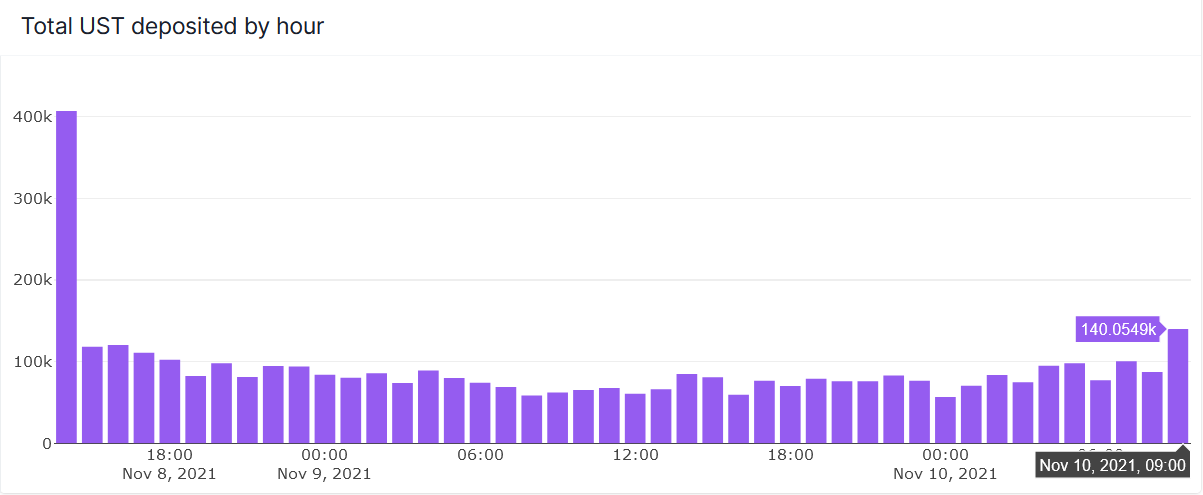
From my understanding, even though the event started at 6AM UTC, users were already able to deposit UST into the event site hence why we see a substantial amount of UST on the first day. On the other days, the daily UST received ranges between 60k to 100k UST consistently for 40+ hours - not too shabby for a fundraising / NFT minting sale. We also see the event managed to end with some hype as it ended with 140k in the last hour.
Overall, the total UST deposited from this event amounted to 3.98M UST. This is akin to a 10k NFT Mint costing 398 UST per mint or about 8 Luna (at the time of writing) per mint.
But unlike a 10k NFT mint, we can see from the graph below that there are 41.6k ‘NFTs’ in the form of meteors minted instead.
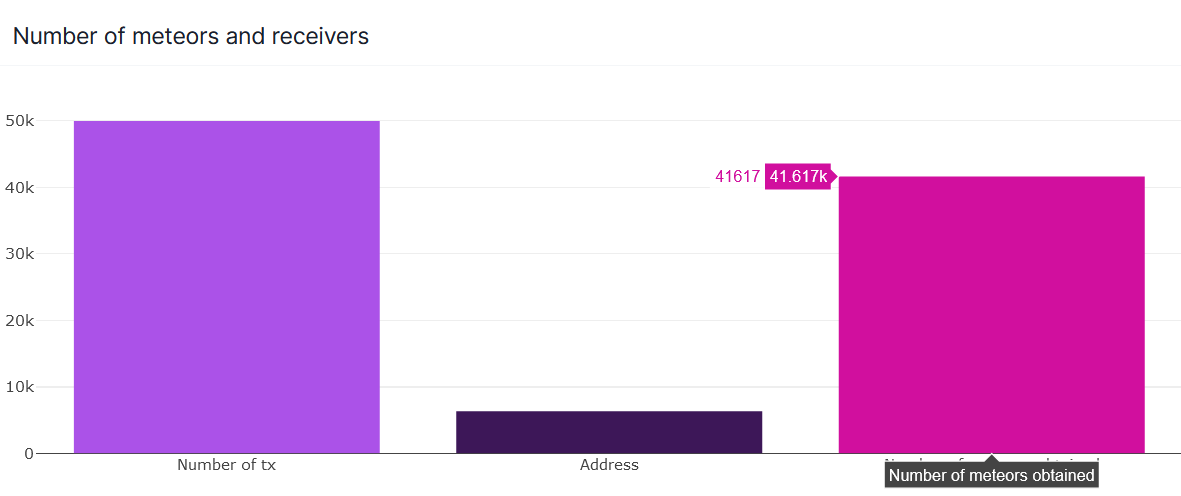
A total of 6339 addresses participated which means on average each address received 6 - 7 meteors from this event!
One difference this event has over usual NFT mints is that there is not theoretical cap to the number of meteors whereas in 10k mints, scarcity theoretically drives demand and price. However, the same can’t be said here where the volume is still high even though supply is unlimited.
Here, mints are directly correlated with effort - if they put effort to bid every hour during the 44 hour event, they could get 44 meteors. This effort-based system I feel is a breath of fresh air to the typical 10k mint in the NFT scene and I applaud the Levana team on experimenting.
Distribution of UST ‘donated’
Here’s what we know: 8 UST is the minimum to get a meteor and top 10 bids every hour are guaranteed a legendary meteor. From this, how much are people bidding in each transaction?
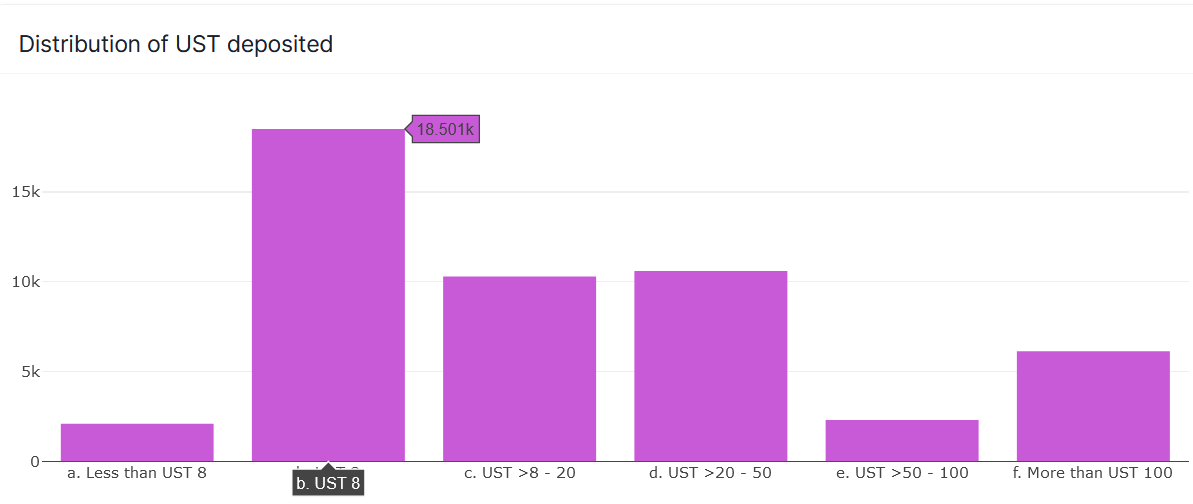
About 37% of all transactions are 8 UST which is the minimum amount. 80% of transactions are below 50 UST - so a majority of the transactions are not ‘whale amounts’ which is a good indication that a lot of retail traders participated in this event.
There are also about 2k transactions with less than 8 UST - those transactions could be users adding more UST on top of their existing bids to potentially qualify for the higher tier meteors.
Legendary meteors! ☄️
Perhaps one of the biggest part of the event is the bid to be in the top 10 each hour to receive a legendary meteor. Let’s see how badly people want these legendaries.
Out of the maximum 440 owners (10 owners per hour for 44 hours), there are only 217 unique owners. This means either legendary owners are likely to bid for more legendaries after winning one, or a few whales are sweeping up a lot of legendaries bringing this average up.
Our suspicions for the latter situation is confirmed through the chart below:
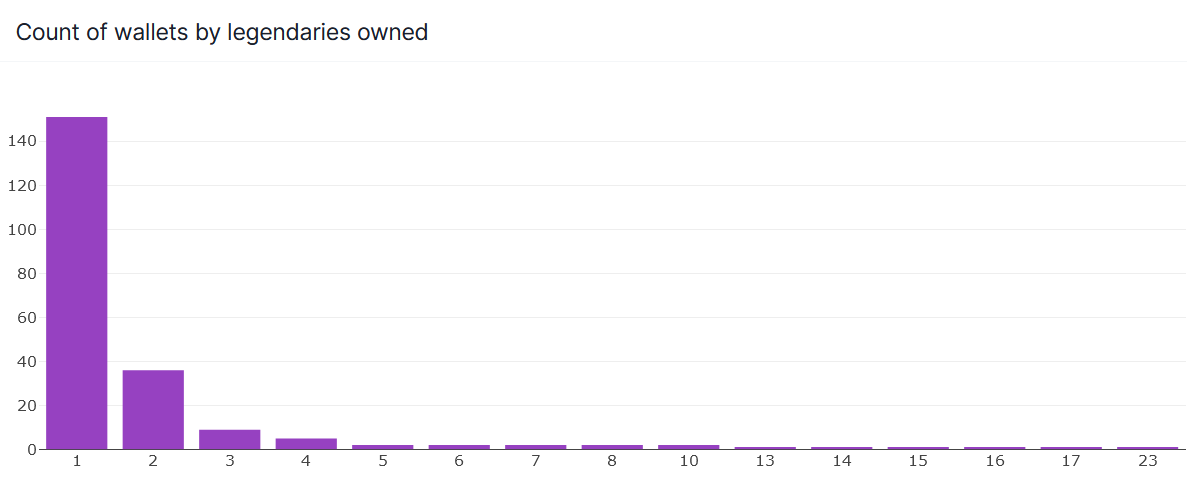
There are 151 wallets that own only 1 legendary but there are whales who own a lot of legendaries - look at the one wallet on the far right that own 23 legendary meteors.
Since we know that there are 151 wallets who own only one legendary, we can extrapolate this and see that the remaining 289 meteors (or 65% of the meteors) are owned by just 66 wallets (30% of total owners). A large amount of meteors are at the hand of very few wallets.
How much is spent buying legendary meteors?
A total of 1,395,220 UST is raised just from 217 wallets - which means 35% of the total fund raised came from just 3% of the total wallets participated.
In terms of the top 10 legendary owners by UST spent, we see that some owners are more effective at bidding than others.
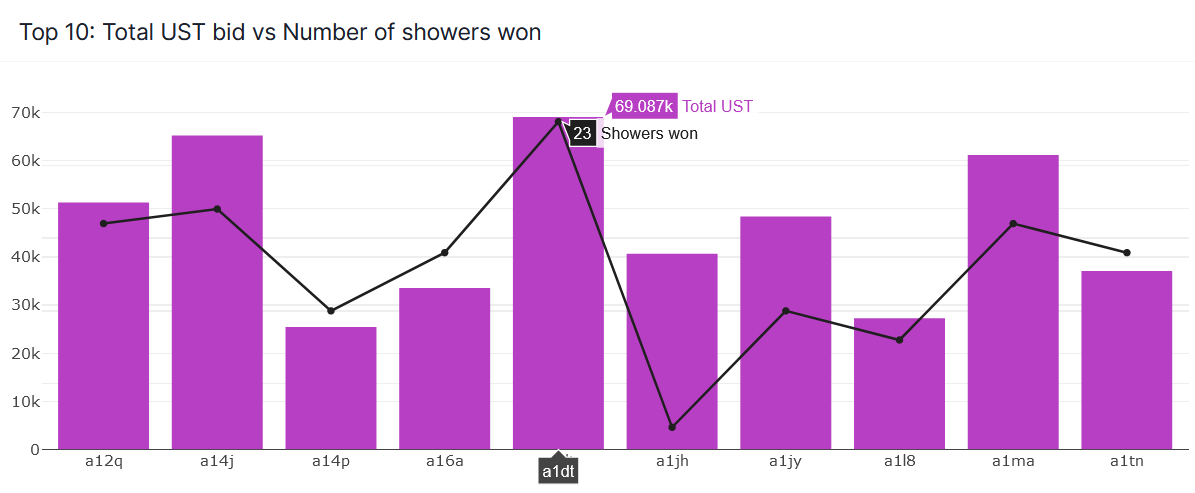
If we look at the graph above, pay attention to address a1dt - they won a whopping 23 legendary meteors by spending 69k UST. Cost per meteor: 3k UST
The address to the right, a1jh on the other hand is not so efficient in their spending where they spent 40.7k UST for only 2 legendary meteors. Cost per meteor: 20k UST
This begs the question, how much on average people are spending based on how many meteors they have won. Do people who win less meteors have a higher average spend?
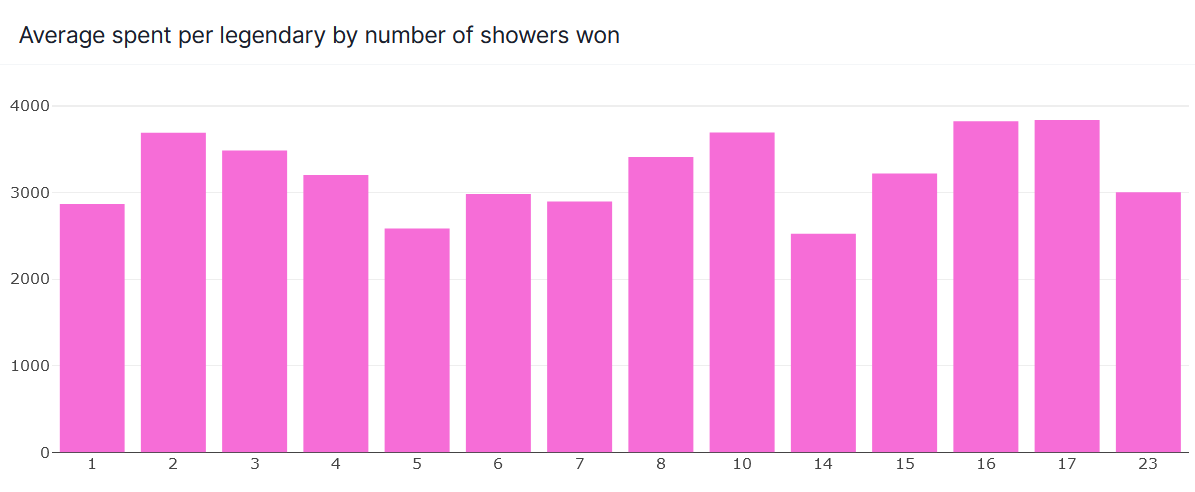
The verdict: Number of legendary meteors won does not correlate to average spend per meteor.
On the x-axis, we have the number of leg’ meteors won and y-axis represent the average UST spent. The average seem to be in the 2500 - 3500 range and has no direct correlation with the amount of meteors won. This also means that the address a1jh is an edge case and just wanted to get their hands on a legendary badly.
Floor and ceiling prices during the event
Why do some people perform better than others? It does seem like there are effective bidding strategies at play here. To look at the possible strategies, I charted the floor and ceiling prices for each hour during the shower.
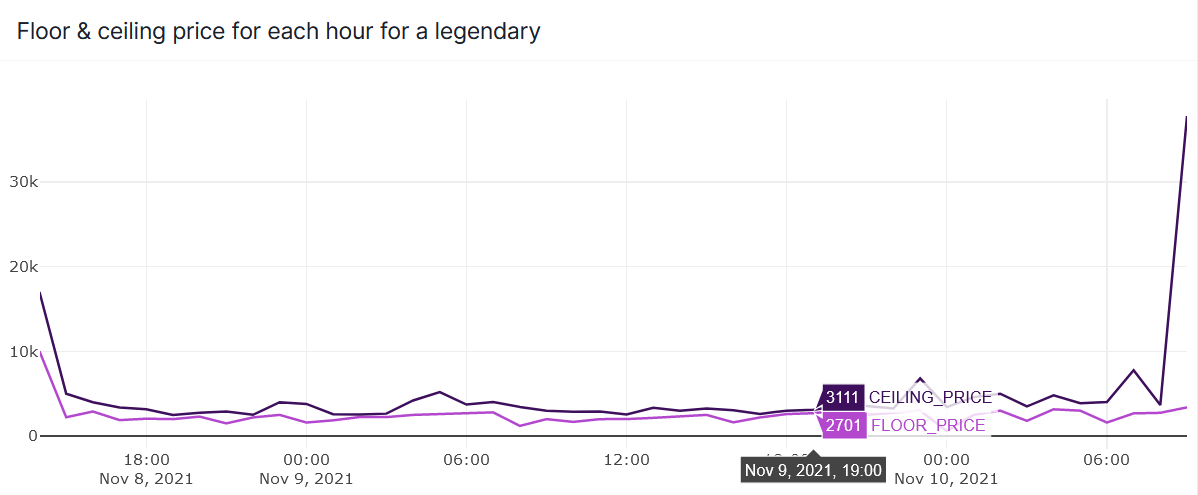
The two obvious observations here is that on the first and last hour, demand spiked and both the floor and ceiling prices went through the roof (pun intended). The other observation is that on the other hours, ceiling and floor prices fluctuate around the same range of 2.7k - 3k UST.
So one possible strategy here seems to be not to bid in the first and the last hour and instead in the hours in between. The floor and ceiling prices should calm down after the first few hours and that’s when we see the consistent 3k range being established, which is when one should start bidding.
It’s interesting to me how people are able to evaluate the value of the legendaries such that the floor and ceiling prices stabilize at the 3k range and remain so for the rest of the event.
Levana Meteor Shower: A successful fundraising event?
In my opinion, the event was a successful one. It served its purpose to bootstrap its Luna 2x leverage product while at the same time experimented on new ways to mint NFTs for the public without a max supply.
Here’s a recap on the key things observed:
Raised a total of almost 4M UST over the span of 44 hours.
6339 addresses particpated, winning about 41k meteors (average 6 -7 meteors per person)
217 addresses now own a legendary meteor. 70% of them own only 1 legendary meteor while 1 addresses owns 23 of them!
some addreses are more efficient at bidding than others but ultimately, it all averages to 3k UST spent per legendary meteor - which is also reflected through the floor and ceiling prices for each hour.
Link to dashboard: https://app.flipsidecrypto.com/dashboard/levana-meteor-shower-event-N3G4yt
Thanks for reading! Have a great week ahead.